Showing posts with label traditional cloth. Show all posts

Di masa silam orang Gayo pernah mengenal bahasan busana dari kulit kayu nanit, hasil tenunan sendiri dari bahan kapas, dan bahan kain yang didatangkan dari luar daerah Gayo. Periode pemakaian nanit sudah jauh dari ingatan orang sekarang, yang konon dipakai pada masa-masa sulit di zaman kolonial Belanda atau masa sebelumnya. Kegiatan bertenun pun sudah lama tak tampak dalam kehidupan mereka, kecuali pada masa pendudukan balatentara Jepang di mana kehidupan serba sulit. Busana yang diperkenalkan di sini dibatasi pada busana sub kelompok Gayo Lut yang berdiam di Kabupaten Aceh Tengah. Uraian tentang busana atau pakaian ini termasuk unsur perhiasan atau assesorisnya yang dikenakan dalam rangka upacara perkawinan, karena di luar upacara itu tidak tampak . adanya ciri busana khas Gayo, lebih-lebih pada zaman masa belakangan ini.

Unsur-unsur pakaian pengantin wanita adalah baju, kain sarung pawak, dan ikat pinggang ketawak. Unsur-unsur perhiasan adalah mahkota sunting, sanggul sempol gampang, cemara, lelayang yang menggantung di bawah sanggul, ilung-ilung, anting-anting subang gener clan subang ilang, yang semuanya itu ada di seputar kepala. Di bagian leher tergantung kalung tangang terbuat dari perak atau uang perak tangang ringit dan tangang birah-mani; clan belgong yang merupakan untaian manik-manik. Kedua lengan sampai ujung jari dihiasi dengan bermacam-macam gelang seperti ikel, gelang iok, gelang puntu, gelang berapit, gelang bulet, gelang beramur, topong, dan beberapa macam cincin sensim belah keramil, sensim genta, sensim patah paku, sensim belilit, sensim keselan, sensim ku I. Bagian pinggang selain ikat pinggang dari kain ketawak, masih ada tali pinggang berupa rantai genit rante; clan di bagian pergelangan kaki ada gelang kaki. Unsur busana lain yang sangat penting adalah upuh ulen-ulen selendang dengan ukuran relatif lebar.

Berbagai gaya sulaman pada baju lengan pendek gaya Gayo. Umumnya baju seperti ini dikenakan oleh anak-anak wanita atau pria. Ukiran Pada Pada Baju Adat Gayo dinamakan dengan Kerawang.

Busana Pengantin Gayo

Busana adat perkawinan Gayo, Aceh Tenggara, mengetengahkan kekayaan teknik sulaman benang warna putih, merah, kuning dan hijau. Pakaian pria dikenal dengan sebutan baju Aman mayak, pakaian wanita disebut Ineun mayak.

Pengantin pria mengenakan bulang pengkah, yang sekaligus berfungsi tempat menancapkan sunting. Unsur lain adalah baju putih, tangang, untaian gelang pada lengan, cincin, kain sarung, genit rante, celana, ponok yakni semacam keris yang diselipkan di pinggang.

Sanggul sempol gampang dengan bentuk tertentu sempol gampang bulet dipakai pada saat akad nikah, dan ada bentuk lain sempol gampang kemang yang dipakai selama 10 hari setelah akad nikah. Sunting yang semacam mahkota itu merupakan susunan perca kertas minyak warna-warni sebagai simbol kebesaran atau keanggunan. Baju pria dan wanita clan celana pria biasanya berwarna hitam. Sedangkan kain sarung adalah semacam songket yang disebut upuh kerung bakasap.

Unsur pakaian yang diberi hiasan adalah upuh ulen-ulen, baju wanita baju kerawang, clan ketawak. Motif-motif hiasan yang selalu muncul pada ketiga unsur pakaian ini adalah: mun berangkat atau mun beriring (awan berarak), pucuk rebung (pucuk rebung), puter tali (pilin berganda), peger (pagar), matan lo (matahari), Wen (bulan). Motif mun berangkat merupakan simbol kesatuan atau kesepakatan; pucuk rebung bermakna ikatan yang teguh; puter tali bermakna kerukunan atau saling tenggang; peger bermakna ketahanan clan ketertiban; matan lo dan ulen adalah kekuatan yang menyinari alam semesta termasuk manusia itu sendiri.

Motif-motif di atas dijahitkan dengan benang berwarna putih, merah, kuning, dan hijau pada latar warna hitam pada selendang upuh ulen-ulen. Kecuali motif matahari clan bulan, motif-motif lainnya dituangkan pula pada baju wanita dengan latar hitam. Motif pada stagen ketawak berlatar kain warna merah muda atau merah bata. Belakangan latar kain tempat menuangkan motif tadi menjadi sangat bervariasi, tergantung pada selera penjahitnya, misalnya biru, kuning, merah, coklat clan lain-lain. Unsur pakaian itu bukan lagi untuk suatu upacara adat seperti perkawinan, tetapi dipakai dalam upacara yang bersifat resmi lainnya. Perkembangan ini ada kecenderungan sebagai memperkuat identitas atau kebanggaan etnik. Pakaian semacam itu dipakai para pejabat dalam menerima tamu terhormat yang datang dari luar daerah, misalnya menteri. Tamu terhormat itu pun disambut penari yang menggunakan "baju adat" baju ketawang dengan berselimut upuh ulen-ulen tadi. Biasanya tamu terhormat atau tamu - agung itu diselimutkan pula dengan kain adat upuh ulen-ulen berkualitas terbaik. Pemberian ini sebagai simbol rasa hormat yang tinggi sekaligus sebagai ungkapan penerimaan yang ikhlas dari masyarakat.

Pada masa yang lebih akhir ini industri kerajinan kain bernuansa adat ini digalakkan oleh pemerintah setempat clan berkembang menjadi industri kerajinan rumah tangga. Motif-motif tadi tidak hanya dituangkan pada busana, tetapi sudah muncul pada kopiah, tas, dompet, taplak meja, bantalan kursi, clan lain-lain. Perkembangan ini dirasakan semakin memantapkan identitas budaya.

Hasil-hasil kerajinan yang muncul dalam berbagai item tadi, yang dikenal dengan kerawang Gayo kebetulan mendapat perhatian pada di luar Gayo. Hal itu menyebabkan tumbuhnya industri "Kerawang Gayo" di luar daerah Gayo, misalnya di Banda Aceh, Medan, Jakarta dan hasilnya muncul di berbagai toko cenderamata di berbagai kota di Indonesia.

Songket is a type of traditional woven cloth Malays. Songket usually woven by hand with gold and silver threads and generally worn on formal occasions.

Songket origins are from ancient trade between China and India. People Tionghoa provide silk, while the Indians contributed gold and silver thread. As a result, be songket.

Songket fabric woven on a frame loom Malays. Intricate patterns are created by introducing the threads of gold or silver with the use of an extra piece of flat needles.

Songket must go through eight ranks before becoming a piece of cloth and still woven traditionally. Because the weavers are usually from the village, it is not surprising that his motives were patterned after the local flora and fauna. This motif was also named to the Malays as a series of local cake is rich, diamonds, and meal tray, which is presumably a king's favorite.

Exclusive songket require between one and three months to complete, while ordinary songket only takes about three days.

At first the man using songket as a headband or headband. Then it began to Malays woman wearing gloves with songket baju kurung. Songket today is a popular choice for wedding dress is often given by the Malays and the bridegroom to the bride as one of the wedding gift.

Judging from the price, songket is not intended only for people who are just because the price varies from the usual and considered to be cheap, exclusive to a very high price.

source : www.wikipedia.org
Clothing regions

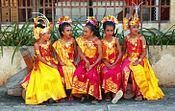
Bali real clothes vary widely, although briefly looks the same. Each area in Bali has a symbolic and characteristic ornaments, based on activities / ritual, gender and age of its users. Social and economic status a person can be identified based on fashion and style of jewelry ornaments she wore.

Men


Traditional clothing men generally consist of:

* Udeng (headband)
* Cain hem
* Umpal (scarf tie)
* Cain Wastra (strapless)
* Belt
* Keris
* A variety of jewelry ornaments


Often the clothes worn shirts, jackets, and footwear as a complement.

Women


Traditional clothing of women generally consist of:

* Bun (bun)
* Sesenteng (strapless songket)
* Cain Wastra
* Belt prada (stagen), twisted her hips and chest
* Shawl songket shoulders down
* Cain tapih or sinjang, next to the
* A variety of jewelry ornaments

Often the kebaya worn, cloth chest, and footwear as a complement.
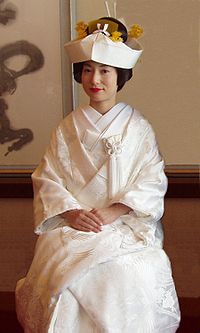
The kimono is a Japanese traditional garment worn by women, men and children. The word "kimono", which literally means a "thing to wear" (ki "wear" and mono "thing"), has come to denote these full-length robes. The standard plural of the word kimono in English is kimonos, kimono is also sometimes used. but the unmarked Japanese plural

Kimonos are T-shaped, straight-lined robes worn so that the hem falls to the ankle, with attached collars and long, wide sleeves. Kimonos are wrapped around the body, always with the left side over the right (except when dressing the dead for burial), and secured by a sash called an obi , which is tied at the back. Kimonos are generally worn with traditional footwear (especially zori or geta ) and split-toe socks (tabi).

Today, kimonos are most often worn by women, and on special occasions. Traditionally, unmarried women wore a style of kimono called furisode, with almost floor-length sleeves, on special occasions. A few older women and even fewer men still wear the kimono on a daily basis. Men wear the kimono most often at weddings, tea ceremonies, and other very special or very formal occasions. Professional sumo wrestlers are often seen in the kimono because they are required to wear traditional Japanese dress whenever appearing in public.

(source)

I am thrilled to open my mailbox and find a dinner party invitation from a certain Indian friend. She's a fabulous cook and my mouth waters to think of her cumin-tinged roasted eggplant. But mostly, I'm eager to see what she's wearing.

Invariably, she greets us in a richly hued sari so stunning that it leaves her dinner guests feeling utterly unimaginative. This time it's embellished with embroidered swirls and tiny reflective mirrors, the kind of textile decoration associated with her native Rajasthan, a partially desert region bordering Pakistan.

Indian textiles count among the richest craft legacies on Earth, encompassing literally thousands of local styles and techniques. Textiles from Rajasthan represent an entire tradition with many sub-specialties, from wood-block prints to tie-dyed cottons and a litany of embroidery techniques long enough to fill a glossary of their own. Through the centuries these rich regional fabrics have constituted a valuable part of women's wedding trousseaus and dowries, identified social status and class, and—through elaborate color symbolism—even conveyed details about the wearer like her hometown and if she is the mother of a boy.

Artisans in Rajasthan begin with cotton threads woven on traditional wooden horizontal looms. Many weavers still use vegetable dyes, including those concocted from turmeric, indigo, saffron, and pomegranate, infused into the fabric with the waters of local rivers. The result: the characteristic vibrant reds, blues, oranges, and yellows so closely associated with Rajasthan, colors that also imbue the region's food and architecture.

Read More

Songket is a type of traditional woven cloth Malays from Indonesia. Songket usually woven by hand with gold and silver thread and is generally worn on formal occasions.

The origins of songket is of ancient trade between China and India. Tionghoa people while providing an Indian silk donate gold and silver thread. As a result, be songket.

Songket woven on a frame loom Malays. Intricate patterns are created by introducing the threads of gold or silver with the use of a single extra flat needles.

Songket must go through eight ranks before becoming a piece of cloth and still woven traditionally. Because the weavers are usually from the village, not surprising that his motives were dipolakan with local flora and fauna. This motif was also named by a local pastry Malays as rich series, diamonds, and flour salver, which is allegedly the king's favorite.

Exclusive songket require between one and three months to complete, while ordinary songket only takes about 3 days.

At first the man using songket as a headband or headband. And then she began to Malays wearing gloves with songket baju kurung. Songket today is a popular choice for wedding clothes Malays and often given by the groom to the bride as a wedding gift.

Judging from the price, songket is not intended only for the public to be just because the price varied from the usual and fairly inexpensive, so that exclusive with a very high price.

Songket is the development of customized fabrics decorative yarn mensisipkan at cloth-making process take place. Making cloth in Indonesia conducted by the gedogan loom very rendah.Teknik manufacturing productivity songket with gedogan tools such as mouth opening movement, the launch of weft and weft density are still there are not a machine loom (ATBM) is setting the movement source and the means supporters more effectively. Research carried out by producing 100 yards songket feed with the loom and ATBM gedogan later time and costs compared. ATBM also used to produce 100 yards songket to determine efeksifitasnya warp in the manufacture of two types of songket. The results showed that ATBM can produce songket feed 3 times faster with more indirect cost saving up to 60.67%. While the production of warp songket faster processing time by 3.55 times the indirect cost savings up to 65.79%.

Woven Fabrics Making Technique

Woven fabric is one of the main types obtained from the crossing of warp threads and weft threads. The formation of woven fabric preparation process begins from the threads of warp like pengelosan, penghanian, pencucukan and weaving, while the weft threads only through the process of polishing and weaving. The process of preparation according Liek Suparli (1979) has the goal of improving the quality of yarn as far as possible and make the roll in accordance with the next process to be not much difficulty, congestion or cause the stains on the fabric due to damage threads. While weaving process, according to Dahlan (1974) includes some basic movements such as opening the mouth warp, launch / insertion perapatan weft and weft (pengetekan)

Cloth Making Technique Songket with Gedogan

Songket fabric is diversifying by adding and setting certain threads during weaving process lasted so obtained woven fabric with a decorative motif of a particular thread. Adding special yarn will determine the type produced songket. If the addition of yarn made in the direction warp yarn fabrics generated so-called songket solution, while adding threads to the weft direction will produce songket feed. Adding special yarn made with menganyakannya in certain places in the basic fabric (woven cloth) to form a motif.

According Suwati Kartiwa (1984), I add an additional string in a way to lift or menjungkit some warp threads and yarns are inserted between the two types of hollow braided yarn base. As for how to make the designs done by calculating the composition of the yarn rates in the form of a pyramid-like shape.

Songket-making process generally done on a loom gedogan driven by hand power and still very simple. Stages of the manufacturing process begins by measuring the change process thread that is rolled into a pile of yarn strict on the box or roll of the spools. Then the process is continued from the process for memalet-weft yarn which is a scrolling process in twisting mill yarn palette (kleting). As for warp threads of stalling the process followed by memani process, namely the warp yarn set in the committee as a tool to determine the length and range of warp yarns to be woven and penggulungannnya on board. Then the threads for the warp was continued by nyisir process or processes pencucukan / enter warp yarn in the hole comb. The next stage is to wipe the process or processes and streamlining pembentangan / leveling and scrolling on the board as a boom loom. End of a series of these processes is the end result of the merger of warp yarns and weft of weaving process.
top