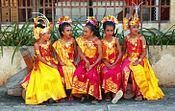
Songket is a type of traditional woven cloth Malays. Songket usually woven by hand with gold and silver threads and generally worn on formal occasions.

Songket origins are from ancient trade between China and India. People Tionghoa provide silk, while the Indians contributed gold and silver thread. As a result, be songket.

Songket fabric woven on a frame loom Malays. Intricate patterns are created by introducing the threads of gold or silver with the use of an extra piece of flat needles.

Songket must go through eight ranks before becoming a piece of cloth and still woven traditionally. Because the weavers are usually from the village, it is not surprising that his motives were patterned after the local flora and fauna. This motif was also named to the Malays as a series of local cake is rich, diamonds, and meal tray, which is presumably a king's favorite.

Exclusive songket require between one and three months to complete, while ordinary songket only takes about three days.

At first the man using songket as a headband or headband. Then it began to Malays woman wearing gloves with songket baju kurung. Songket today is a popular choice for wedding dress is often given by the Malays and the bridegroom to the bride as one of the wedding gift.

Judging from the price, songket is not intended only for people who are just because the price varies from the usual and considered to be cheap, exclusive to a very high price.

source : www.wikipedia.org

Hem batik ini terbuat dari kain katun primis halus yang nyaman dan adem untuk dikenakan, dengan metode pembuatan secara tradisional tulis tangan.

Spesifikasi :

1. Kain katun halus dan adem

2. Jahitan halus

3. Warna Hitam

Harga Eceran : Rp. 99.000,00

Hem batik ini terbuat dari kain katun primis halus yang nyaman dan adem untuk dikenakan, dengan metode pembuatan secara tradisional tulis tangan.

Spesifikasi :

1. Kain katun halus dan adem

2. Jahitan halus dan rapi

3. Warna Hitam

Harga Eceran : Rp. 99.000,00
Clothing regions

Bali real clothes vary widely, although briefly looks the same. Each area in Bali has a symbolic and characteristic ornaments, based on activities / ritual, gender and age of its users. Social and economic status a person can be identified based on fashion and style of jewelry ornaments she wore.

Men


Traditional clothing men generally consist of:

* Udeng (headband)
* Cain hem
* Umpal (scarf tie)
* Cain Wastra (strapless)
* Belt
* Keris
* A variety of jewelry ornaments


Often the clothes worn shirts, jackets, and footwear as a complement.

Women


Traditional clothing of women generally consist of:

* Bun (bun)
* Sesenteng (strapless songket)
* Cain Wastra
* Belt prada (stagen), twisted her hips and chest
* Shawl songket shoulders down
* Cain tapih or sinjang, next to the
* A variety of jewelry ornaments

Often the kebaya worn, cloth chest, and footwear as a complement.
Javanese batik art is a cultural heritage of Indonesia, especially Java-controlled areas of Java from generation to generation. Javanese Batik motifs has an different. The difference is common motives motives dikarnakan it has meaning, that is not just an image but it implies that they can from their ancestors, the religion of animism, dynamism, or Hinduism and Buddhism. Javanese Batik in many developing regions Solo or commonly known as Solo batik.


(Pekalongan batik Buketan origin with European design influence)
Batik is a craft that has high artistic value and has become part of the culture of Indonesia (especially Java) for a long time. Javanese women in the past made their skills in batik for a living, so in the past, batik work is exclusively women's work until the invention of "Batik Cap" which allows the entry of men into the field. There are some exceptions to this phenomenon, namely that the coastal batik masculine lines as you can see in shades of "Mega Clouds", which in some coastal areas batik work is common for men.

Batik tradition was originally a hereditary tradition, so occasionally a recognizable motif batik originated from a particular family. Some batik motif can indicate the status of a person. Even today, some tadisional batik motif is only used by the family court of Yogyakarta and Surakarta.

see more

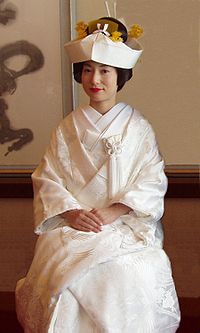
The kimono is a Japanese traditional garment worn by women, men and children. The word "kimono", which literally means a "thing to wear" (ki "wear" and mono "thing"), has come to denote these full-length robes. The standard plural of the word kimono in English is kimonos, kimono is also sometimes used. but the unmarked Japanese plural

Kimonos are T-shaped, straight-lined robes worn so that the hem falls to the ankle, with attached collars and long, wide sleeves. Kimonos are wrapped around the body, always with the left side over the right (except when dressing the dead for burial), and secured by a sash called an obi , which is tied at the back. Kimonos are generally worn with traditional footwear (especially zori or geta ) and split-toe socks (tabi).

Today, kimonos are most often worn by women, and on special occasions. Traditionally, unmarried women wore a style of kimono called furisode, with almost floor-length sleeves, on special occasions. A few older women and even fewer men still wear the kimono on a daily basis. Men wear the kimono most often at weddings, tea ceremonies, and other very special or very formal occasions. Professional sumo wrestlers are often seen in the kimono because they are required to wear traditional Japanese dress whenever appearing in public.

(source)

top